URANUS IN GEMINI, PART 1: THE CLOCK THAT NEVER LIES
by Mark A. Shryock

This is Part 1 of a two-part series. Part 2 — Uranus in Gemini, Part 2: What the Clock Is Telling You to Do — covers what this pattern means for how you live right now.
April 25, 2026, at 8:50 PM Eastern. Uranus entered Gemini at zero degrees.
This is not an astrology column. This is a thousand-year dataset that happens to be written in the sky.
Every 84 years, when Uranus crosses into Gemini, the dominant civilization of the era collapses. The currency system breaks. The communication technology of the age is replaced. A war marks the transition. And by the time Uranus leaves Gemini seven years later, a new culture is operating that the old one could not have imagined. This has happened twelve times in recorded history. It has never failed.
But 2026 is not a normal 84-year cycle.
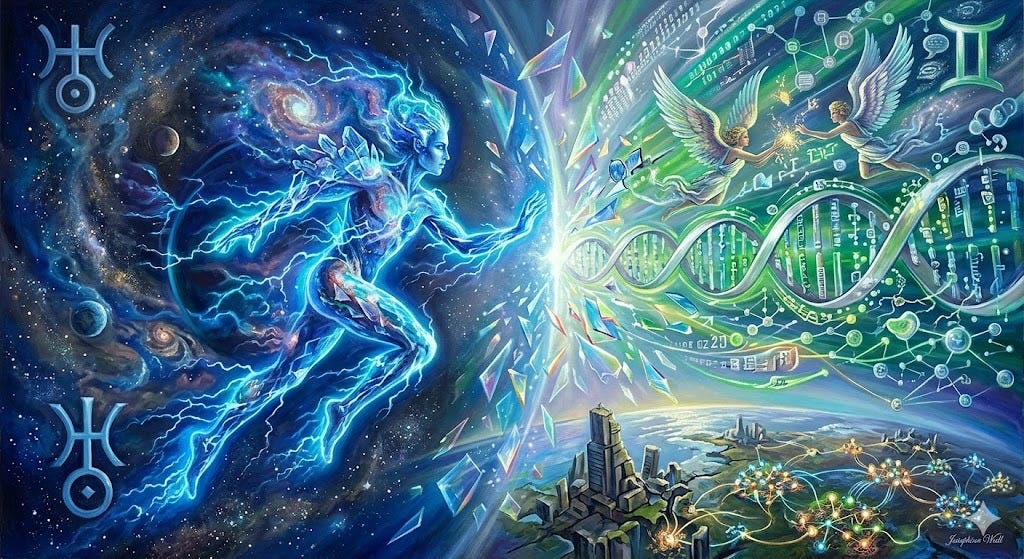
This April, Uranus hit zero degrees Gemini sixty-four days after a Saturn-Neptune conjunction at zero degrees Aries — a configuration that last occurred roughly six to nine thousand years ago, around the birth of agriculture and the first settled cities. Pluto is simultaneously in Aquarius, a 248-year revolution that last dismantled empires during the American and French Revolutions. And the precession of the equinoxes — the 26,000-year wobble of the Earth that marks the shift from the Age of Pisces to the Age of Aquarius — is crossing its hinge point now.
The Chinese calendar marks 2026 as the Year of the Fire Horse, a sixty-year cycle of double fire that last burned through in 1966, the year the Cultural Revolution began. The Yoruba Ifa oracle names 2026 as Ogunda Otrupon, warning of rising violence, the breakdown of social structures, and a period requiring discipline and restoration of community bonds. Vedic calculation places the end of Kali Yuga — the darkest age of materialism and extraction — at this same threshold. The Hopi prophecy describes our era as the end of the Fourth World and the emergence into the Fifth, with signs already visible: the atomic gourd of ashes, the spider web across the Earth, and a final spiritual conflict fought with material means. The Mayan Long Count, a 5,125-year cosmic calendar, entered a new world-age in 2012. 2026 sits in the opening years of that regeneration cycle.
These systems were built independently across continents and millennia. They do not read each other’s texts. They all point to this window.
THE TIMELINE
The historical data shows the trigger comes within months to two years of ingress. The bifurcation point — where the old order is mathematically dead and the new one is irreversible — arrives in years three to five. By the time Uranus enters Cancer in 2033, the transformation is complete.
Years 0 to 2 (2026 to 2028): The trigger. Systemic seizure. The old economic model fractures because the math becomes visible to everyone. A crisis event — economic, military, or both — forces the break.
Years 3 to 5 (2029 to 2031): The bifurcation. The old system starves from non-participation. New localized systems become irreversible.
Years 6 to 7 (2032 to 2033): Integration complete. Two realities are structurally distinct. The old institutions are hollow shells. The new culture is operational.
What follows is the proof. Every cycle. Every war. Every currency collapse. Every communication revolution. Every culture that fell and rose. One thousand years. No exceptions.
CYCLE 12 — 1941 TO 1949
War and Crisis: World War II. Nazi Germany invades the Soviet Union in June 1941. Pearl Harbor draws the United States into the war in December 1941. Germany surrenders May 1945. Atomic bombs dropped on Hiroshima and Nagasaki in August 1945. The Holocaust — six million Jews and millions of others systematically exterminated.
Economic and Monetary: Bretton Woods in 1944 establishes the U.S. dollar as global reserve currency. The IMF and World Bank are created. Post-war price controls lifted in 1946 trigger inflation spikes. The old British pound-centered global system ends permanently.
Communication and Technology: Codebreaking machines at Bletchley Park are breaking German Enigma transmissions daily by 1941. The first programmable electronic computer, Colossus, is built at Bletchley Park in 1943. Radar developed. Jet aircraft developed. Television and the microwave change domestic life permanently.
Cultural Death and Birth: Nazi Germany — dominant and murderous — completely destroyed. Japan’s empire obliterated. The British Empire fatally weakened. China’s ancient governing structure replaced by Mao’s communism in 1949. The world splits into two ideological camps: U.S. capitalism versus Soviet communism. The atomic age and the computer age begin simultaneously. The United States becomes the center of a new world order.
CYCLE 11 — 1858 TO 1866
War and Crisis: U.S. Civil War 1861 to 1865. Two percent of the U.S. population dies. The Second Opium War from 1856 to 1860 shatters China’s tribute system. The Taiping Rebellion from 1850 to 1864 ends — one of history’s deadliest civil wars, waged against the Qing Dynasty.
Economic and Monetary: U.S. Greenbacks created in 1862 — the first fiat paper currency in America. National Banking Acts of 1863 and 1864 override state banks and centralize the financial system. Britain’s cotton-textile economy is disrupted by the Southern blockade.
Communication and Technology: First transatlantic telegraph cable in 1865. First underground railway opens in 1863. First submarine launched. Widespread newspaper war coverage. Railroad logistics transform warfare permanently.
Cultural Death and Birth: The antebellum Southern plantation civilization is obliterated — slavery abolished, economy collapsed, culture does not rebuild in recognizable form. The industrial North ascends. Serfdom ends in Russia in 1861 simultaneously with American slaves being freed. Darwin publishes Origin of Species in 1859, permanently changing the scientific framework for understanding life itself.
CYCLE 10 — 1774 TO 1782
War and Crisis: American Revolutionary War 1775 to 1783. First Anglo-Maratha War in India. Russian-Ottoman conflicts ongoing.
Economic and Monetary: Continental currency issued by Congress hyperinflates and collapses. Adam Smith publishes The Wealth of Nations in 1776, reframing how nations understand economics. Britain’s global dominance begins its long terminal decline.
Communication and Technology: Watt’s steam engine commercialized. Mass pamphleteering and political printing in the colonies. Planet Uranus officially discovered in 1781.
Cultural Death and Birth: British colonial rule in North America ends. The United States is born as a new model republic. Austria introduces compulsory education for boys and girls in 1774. The old mercantile empire model begins losing its grip on the world.
CYCLE 9 — 1690 TO 1698
War and Crisis: The Nine Years War from 1688 to 1697 — the first truly global war involving Europe, North America, and the Caribbean. Salem Witch Trials in 1692.
Economic and Monetary: The Bank of England founded in 1694 — the model for modern central banking as we know it. National debt as a governing tool formalized in Britain for the first time in history. First paper money in the Western world used in the American colonies in 1690 to 1691. The Recoinage Act of 1696 removes counterfeit silver from circulation.
Communication and Technology: Locke publishes Two Treatises on Government in 1690, reshaping political philosophy across the Western world.
Cultural Death and Birth: Absolute monarchy in England permanently checked by the Glorious Revolution settlement. The age of witch burnings ends in the West. Russia transforms into a major European power under Peter the Great. The last independent Mayan resistance in the Americas is eliminated by Spain in 1697. A major volcanic eruption in 1695 triggers crop failure — the Great Famine of 1695 to 1697 kills a third of Finland’s population.
CYCLE 8 — 1606 TO 1614
War and Crisis: Eighty Years War and Dutch-Spanish conflict ongoing. Ottoman-Safavid wars. Constant colonial and religious warfare across multiple continents.
Economic and Monetary: The Dutch East India Company dominates Asian trade. The British East India Company expands. Jamestown in 1607 and Quebec in 1608 establish permanent extraction economies in North America. The Bank of Amsterdam founded in 1609. First checks introduced.
Communication and Technology: The telescope invented in 1608 and 1609. Galileo’s astronomical discoveries in 1610. Kepler’s Laws of Planetary Motion published in 1609. The first regular newspapers published in Germany in 1605 and 1609. The King James Bible standardizes English religious text in 1611.
Cultural Death and Birth: The Tokugawa Shogunate establishes 250 years of Japanese isolation in 1603, ending the Sengoku civil-war era permanently. The Time of Troubles in Russia ends in 1613 with the Romanov dynasty — a new autocratic order that will hold for 300 years. The scientific worldview begins replacing the theological worldview as the primary framework for understanding reality.
CYCLE 7 — 1523 TO 1530
War and Crisis: The German Peasants War from 1524 to 1525 — between 100,000 and 300,000 dead, the largest popular uprising in European history before 1789. Ottoman Sultan Suleiman conquers Belgrade and Rhodes. The Spanish conquest of the Aztec Empire is completed.
Economic and Monetary: Massive wealth transfer from the Americas to Spain begins. Price inflation erupts in Europe as silver floods in. Traditional feudal obligations collapse in Germany as the economic order fractures.
Communication and Technology: The printing press spreads Luther’s ideas across Europe faster than any authority can stop them. Mass pamphleteering. Bible translations into vernacular languages.
Cultural Death and Birth: The Aztec civilization is destroyed — Tenochtitlan falls in 1521. The Inca Empire is under siege. The Lutheran Reformation splits Western Christendom permanently. The Catholic Church’s monopoly on knowledge is permanently fractured. The Holy Roman Empire’s medieval unity is shattered. Gustav Vasa is elected King of Sweden in 1523, ending Danish rule permanently.
CYCLE 6 — 1439 TO 1447
War and Crisis: The Hundred Years War ongoing — Joan of Arc burned in 1431. The Ottoman Empire closes in on Constantinople, which falls in 1453 immediately after this window.
Economic and Monetary: The Great Bullion Famine grips Europe. The Great Slump in England from the 1430s through the 1480s — severe depression, mint output collapses, credit crunch, cloth exports fall between 35 and 90 percent in some regions.
Communication and Technology: Gutenberg develops movable-type printing press around 1440. The Hangul writing system created in Korea in 1443. Multiple universities founded — Eton in 1440, King’s College Cambridge in 1441.
Cultural Death and Birth: The medieval feudal economy enters crisis. The old scribal and church-controlled knowledge system begins its death spiral as print culture rises. The Byzantine Empire enters its final throes. Portuguese systematic exploration of Africa begins. The Mayan civilization of Mayapan fractures into warring city-states. The Atlantic slave trade begins — first enslaved Africans brought to Portugal in 1441.
CYCLE 5 — 1355 TO 1363
War and Crisis: Hundred Years War — Battle of Poitiers in 1356, French King John II captured by the English. The Jacquerie peasant rebellion in 1358 crushed violently. The Red Turban Rebellion begins in China in 1351, leading to the Yuan Dynasty’s collapse. Scotland’s Burnt Candlemass in 1356 — Edward III burns down entire sections of the country.
Economic and Monetary: Severe labor shortage across Europe after the Black Death of 1347 to 1351. Wages spike between 20 and 67 percent in England. Currency debasements spread. The manorial system breaks down as serfs begin demanding cash wages. The Hanseatic League holds its first formal meeting in 1357.
Communication and Technology: Social upheaval forces new record-keeping and legal documentation across Europe.
Cultural Death and Birth: The Mongol Empire begins its global collapse. The Yuan Dynasty in China effectively falls in 1368 to the Ming. Feudalism in Europe begins its terminal decline. New governing documents replace old power structures — the Golden Bull of 1356. A dominant trade alliance formalizes as old empires collapse around it.
CYCLE 4 — 1271 TO 1279
War and Crisis: Kublai Khan declares the Yuan Dynasty in 1271, completing the Mongol conquest of Song China by 1279 — a massive war of annihilation against the most sophisticated civilization on Earth. The Ninth Crusade from 1271 to 1272 is the last major Crusader expedition. The Mamluks destroy the remaining Crusader holdings.
Economic and Monetary: The Yuan Dynasty issues paper currency — the first fiat money at scale in world history. The Pax Mongolica creates transcontinental trade routes. Renten emission (public bond finance) becomes standard across Europe in 1276.
Communication and Technology: Block printing mature in China. The magnetic compass in wide use. Thomas Aquinas completes Summa Theologica. The Avesta — the core text of Zoroastrianism — is transcribed from oral tradition for the first time in 1278.
Cultural Death and Birth: The Song Dynasty — the height of classical Chinese civilization — is destroyed by foreign conquest. For the first time in history, all of China is ruled by a non-Han dynasty. The Crusader states in the Holy Land are effectively ended. The Habsburg dynasty is founded in Europe in 1273 — it will rule until 1918. A 23-year drought begins in the Grand Canyon in 1276, forcing agricultural peoples including the Anasazi entirely out of the region.
CYCLE 3 — 1188 TO 1195
War and Crisis: The Third Crusade from 1189 to 1192 — Saladin versus Richard Lionheart. Jerusalem falls to Muslim forces in 1187. The Crusaders fail to retake it. Frederick Barbarossa drowns in 1190 and the German army collapses.
Economic and Monetary: The Saladin Tithe — a 10 percent tax — levied across England and France to finance the Crusade. Massive war financing strains royal treasuries to breaking. The Italian maritime republics of Venice and Genoa profit from transport and supply.
Communication and Technology: Chivalric literature and troubadour culture peak, spreading new social codes via oral and written transmission across Europe.
Cultural Death and Birth: The Crusader Kingdom of Jerusalem effectively ends — surviving only on the coast. The Ayyubid dynasty under Saladin solidifies Muslim control of the Levant. The Kamakura Shogunate is established in Japan in 1192, beginning warrior rule and permanently ending classical Heian court culture. The Itza people are driven from Chichen Itza in 1194 and forced to found a new kingdom in Guatemala — a dominant culture expelled and erased.
CYCLE 2 — 1104 TO 1112
War and Crisis: Crusader states consolidate in the Levant. Crusade of 1101 ends in disaster. Ongoing warfare between Crusaders and Muslim states. The Investiture Controversy between Pope and Holy Roman Emperor deepens. An anti-pope is elected in 1105 and forced to abdicate in 1111.
Economic and Monetary: Italian city-states — Venice, Genoa, Pisa — rise as financial powers funding the Crusades. The feudal land tenure system is exported to the Levant.
Communication and Technology: Cathedral schools and early universities emerging across Europe. Chinese authorities print paper money in three colors to prevent counterfeiting in 1107 — an early currency security system.
Cultural Death and Birth: The First Crusade establishes a permanent Latin Christian presence in the Levant. The Song Dynasty in China is at a cultural golden age but under growing military pressure. Great Zimbabwe emerges as a regional power in Southern Africa.
CYCLE 1 — 1020 TO 1028
War and Crisis: No major world war. Byzantine-Georgian wars end in 1022. Cnut the Great conquers Norway in 1028, ruling the North Sea Empire of England, Norway, and Denmark.
Economic and Monetary: The Byzantine gold nomisma remains the standard currency, but Basil II’s death in 1025 begins its slow decline. The European economy is largely agrarian and local.
Communication and Technology: Avicenna publishes the Canon of Medicine and The Book of Healing — works that shape European medicine until the 17th century. Chinese engineer Yan Su reinvents the south-pointing chariot (mechanical compass) in 1027.
Cultural Death and Birth: The death of Basil II ends the Macedonian Renaissance and begins the long Byzantine decline. The Truce of God declared in 1027 — the largest mass peace movement in recorded history — establishes rules restricting noble violence across the Carolingian Empire, permanently protecting women, clergy, field workers, pilgrims, and merchants. The first recorded burning for heresy in the medieval West takes place in 1022 in France.
WHAT THE DATA SHOWS
In all twelve cycles without exception, a dominant communication technology is replaced.
In eleven of twelve cycles, a major war marks the transition — either at the ingress or within two years of it.
In every cycle, the financial system of the dominant civilization is restructured or collapses.
In every cycle, a dominant culture is either destroyed, permanently weakened, or replaced by something it could not have anticipated.
Copyright © Mark A. Shryock — May be shared with attribution.
SOURCES
ASTRONOMICAL AND CYCLICAL REFERENCES
Ephemeris data for Uranus ingress into Gemini, April 25, 2026, at 8:50 PM EST, confirmed across multiple astronomical and astrological calculation platforms including Astro.com Swiss Ephemeris, Cafe Astrology, Moon Omens, and the Old Farmer’s Almanac astronomical tables.
Saturn-Neptune conjunction at zero degrees Aries, February 20, 2026. Orbital period approximately 36 years. Prior conjunction at zero degrees Aries estimated at approximately 7,000 BCE, coinciding with the Neolithic agricultural transition. Maurice Fernandez, “The Great Saturn-Neptune Conjunction at 0 Aries 2025-2026,” MauriceFernandez.com, February 2026.
Pluto ingress into Aquarius, November 2024. Orbital period 248 years. Prior Aquarius transits: 1778 to 1798 (American and French Revolutions). NASA Jet Propulsion Laboratory Horizons System, planetary ephemeris data.
Precession of the equinoxes. 25,772-year cycle. International Astronomical Union, General Assembly resolution on astronomical reference frames.
Chinese sexagenary calendar: 2026 as Bingwu, Year of the Fire Horse, sixty-year cycle. Hu Ying, Professor of East Asian Studies, University of California Irvine, “Lunar New Year 2026: A Year of Reckoning,” UCI School of Humanities, February 17, 2026. Prior Fire Horse year 1966, confirmed by demographic records showing Japan’s birth rate dropped 25 percent due to Hinoeuma superstition.
Yoruba Ifa divination: Ogunda Otrupon designated as ruling sign for 2026. Letra del Ano ceremony conducted December 31, 2025, by the Yoruba Cultural Association of Cuba (Institucion Religiosa Asociacion Cultural Yoruba de Cuba), Prado 615, Old Havana. Presided over by senior Ifa priest Carlos Argudin Valenzuela. Reported by CubaHeadlines, CiberCuba, and Botanica Online, January 1, 2026.
Vedic Yuga system and Kali Yuga chronology. Multiple traditional Hindu astronomical calculations. See Swami Sri Yukteswar, “The Holy Science” (1894), for the compressed Yuga cycle model.
Hopi prophecy: Fourth World to Fifth World transition. Signs including the gourd of ashes (nuclear weapons), spider web across the Earth (power grid and telecommunications), and a final spiritual conflict fought with material means. Frank Waters, “Book of the Hopi” (Viking Press, 1963), compiled from accounts of thirty Hopi elders. Thomas Banyacya, address to the United Nations General Assembly, December 1992.
Mayan Long Count calendar: 5,125-year Great Cycle, thirteenth baktun transition completed December 21, 2012. Michael D. Coe, “The Maya” (Thames and Hudson, multiple editions). Robert Sharer and Loa Traxler, “The Ancient Maya” (Stanford University Press, 6th edition, 2006).
HISTORICAL SOURCES BY CYCLE
Cycle 12, 1941 to 1949
Bretton Woods Agreement, 1944. International Monetary Fund, “Articles of Agreement of the International Monetary Fund,” July 22, 1944. Benn Steil, “The Battle of Bretton Woods” (Princeton University Press, 2013).
World War II chronology. United States Holocaust Memorial Museum, Holocaust Encyclopedia. National WWII Museum, New Orleans, timeline resources. John Keegan, “The Second World War” (Viking, 1989).
Codebreaking machines at Bletchley Park. Turing-Welchman Bombe first installed March 14, 1940, operational against Enigma daily by 1941. Colossus, first programmable electronic computer, operational 1943. The National Museum of Computing, Bletchley Park. Encyclopaedia Britannica, “Bombe.” B. Jack Copeland, “Colossus: The Secrets of Bletchley Park’s Codebreaking Computers” (Oxford University Press, 2006).
Cycle 11, 1858 to 1866
U.S. Civil War. James McPherson, “Battle Cry of Freedom: The Civil War Era” (Oxford University Press, 1988). Two percent population loss figure from J. David Hacker, “A Census-Based Count of the Civil War Dead,” Civil War History, Vol. 57, No. 4, December 2011.
Greenbacks and National Banking Acts. Milton Friedman and Anna Schwartz, “A Monetary History of the United States, 1867-1960” (Princeton University Press, 1963). Wesley Clair Mitchell, “A History of the Greenbacks” (University of Chicago Press, 1903).
Transatlantic telegraph cable, 1865 to 1866. Bill Burns, “History of the Atlantic Cable and Undersea Communications,” Atlantic-Cable.com, primary source archive.
Darwin, “On the Origin of Species,” published November 24, 1859. John Murray, London.
Taiping Rebellion, 1850 to 1864. Jonathan Spence, “God’s Chinese Son: The Taiping Heavenly Kingdom of Hong Xiuquan” (W.W. Norton, 1996). Estimated 20 to 30 million dead.
Emancipation of serfs in Russia, 1861. Alexander II, Emancipation Manifesto, March 3, 1861.
Cycle 10, 1774 to 1782
American Revolution. Gordon Wood, “The Radicalization of the American Revolution” (Vintage, 1993). Continental currency hyperinflation documented in E. James Ferguson, “The Power of the Purse” (University of North Carolina Press, 1961).
Adam Smith, “An Inquiry into the Nature and Causes of the Wealth of Nations,” published March 9, 1776, London.
Watt steam engine. Boulton and Watt commercial partnership established 1775.
Discovery of Uranus by William Herschel, March 13, 1781. Royal Astronomical Society archives.
Austrian compulsory education, 1774. Allgemeine Schulordnung, Maria Theresa, December 6, 1774.
Cycle 9, 1690 to 1698
Nine Years War, 1688 to 1697. John A. Lynn, “The Wars of Louis XIV, 1667-1714” (Longman, 1999).
Bank of England, founded 1694. Bank of England official history, BankOfEngland.co.uk. Royal Charter granted July 27, 1694, by King William III and Queen Mary II. Encyclopaedia Britannica, “Bank of England.” Sweden’s Riksbank (1668) is the oldest central bank; the Bank of England is widely recognized as the model for modern central banking.
Salem Witch Trials, 1692. Mary Beth Norton, “In the Devil’s Snare: The Salem Witchcraft Crisis of 1692” (Vintage, 2003).
Massachusetts Bay Colony paper money, 1690. First paper currency issued in British North America. Leslie Brock, “The Currency of the American Colonies, 1700-1764” (Arno Press, 1975).
Recoinage Act, 1696. Managed by Isaac Newton as Warden of the Royal Mint.
John Locke, “Two Treatises of Government,” published 1689 (dated 1690). Cambridge University Press critical edition.
Great Famine, Finland, 1695 to 1697. Andrew Appleby, “Epidemics and Famine in the Little Ice Age,” Journal of Interdisciplinary History, 1980. One-third population loss figure from Finnish historical demographic records.
Fall of Nojpeten (Tayasal), last independent Maya polity, to Spain, March 13, 1697. Grant Jones, “The Conquest of the Last Maya Kingdom” (Stanford University Press, 1998).
Cycle 8, 1606 to 1614
Dutch East India Company (VOC), founded 1602. Femme Gaastra, “The Dutch East India Company” (Walburg Pers, 2003).
Jamestown, 1607. National Park Service, Jamestown historical documentation.
Bank of Amsterdam (Wisselbank), founded 1609. Stephen Quinn and William Roberds, “The Bank of Amsterdam and the Leap of Faith,” Federal Reserve Bank of Atlanta Working Paper, 2007.
Telescope invention, 1608. Hans Lippershey, patent application, October 2, 1608, States General of the Netherlands. Galileo’s telescopic observations published in “Sidereus Nuncius,” March 1610.
Kepler, “Astronomia Nova,” published 1609.
King James Bible, first published 1611.
First regular newspapers in Germany: “Relation” (Strasbourg, 1605) and “Aviso” (Wolfenbuttel, 1609).
Tokugawa Shogunate established 1603. Conrad Totman, “Tokugawa Ieyasu: Shogun” (Heian, 1983).
Romanov dynasty begins 1613. Lindsey Hughes, “The Romanovs” (Continuum, 2008).
Cycle 7, 1523 to 1530
German Peasants War, 1524 to 1525. Peter Blickle, “The Revolution of 1525: The German Peasants’ War from a New Perspective” (Johns Hopkins University Press, 1981). Casualty estimates 100,000 to 300,000.
Fall of Tenochtitlan, August 13, 1521. Hugh Thomas, “Conquest: Cortes, Montezuma, and the Fall of Old Mexico” (Simon and Schuster, 1993).
Luther and the printing press. Andrew Pettegree, “Brand Luther: How an Unheralded Monk Turned His Small Town into a Center of Publishing” (Penguin, 2015).
Gustav Vasa elected King of Sweden, June 6, 1523.
Cycle 6, 1439 to 1447
Gutenberg movable-type printing press, developed approximately 1439 to 1440. Earliest documented reference, Strasbourg lawsuit, 1439. Encyclopaedia Britannica, “Johannes Gutenberg.” Albert Kapr, “Johann Gutenberg: The Man and His Invention” (Scolar Press, 1996).
Hangul, created 1443 under King Sejong the Great. Promulgated 1446 as Hunminjeongeum. National Institute of Korean History.
Great Bullion Famine, fifteenth century Europe. John Day, “The Great Bullion Famine of the Fifteenth Century,” Past and Present, No. 79, May 1978.
Great Slump in England. John Hatcher, “The Great Slump of the Mid-Fifteenth Century,” in Richard Britnell and John Hatcher, eds., “Progress and Problems in Medieval England” (Cambridge University Press, 1996). Cloth export decline figures from E.M. Carus-Wilson and Olive Coleman, “England’s Export Trade, 1275-1547” (Oxford University Press, 1963).
Fall of Constantinople, May 29, 1453. Roger Crowley, “1453: The Holy City’s Last Great Siege” (Hyperion, 2005).
Portuguese exploration of Africa begins under Prince Henry the Navigator. Peter Russell, “Prince Henry ‘the Navigator’” (Yale University Press, 2000).
First enslaved Africans brought to Portugal, 1441. Hugh Thomas, “The Slave Trade: The Story of the Atlantic Slave Trade” (Simon and Schuster, 1997).
Cycle 5, 1355 to 1363
Battle of Poitiers, September 19, 1356. Jonathan Sumption, “The Hundred Years War, Volume II: Trial by Fire” (University of Pennsylvania Press, 2001).
Jacquerie, 1358. Samuel K. Cohn Jr., scholarship on European peasant revolts.
Red Turban Rebellion and Yuan Dynasty collapse. Frederick Mote, “Imperial China, 900-1800” (Harvard University Press, 1999).
Post-Black Death labor economics. Christopher Dyer, “Standards of Living in the Later Middle Ages” (Cambridge University Press, 1989).
Golden Bull of 1356. Len Scales, “The Shaping of German Identity: Authority and Crisis, 1245-1414” (Cambridge University Press, 2012).
Hanseatic League first formal assembly, 1356. Philippe Dollinger, “The German Hansa” (Stanford University Press, 1970).
Cycle 4, 1271 to 1279
Kublai Khan declares Yuan Dynasty, 1271. Morris Rossabi, “Khubilai Khan: His Life and Times” (University of California Press, 1988).
Mongol conquest of Song China completed 1279. Herbert Franke and Denis Twitchett, “The Cambridge History of China, Volume 6: Alien Regimes and Border States” (Cambridge University Press, 1994).
Yuan paper currency. Richard von Glahn, “Fountain of Fortune: Money and Monetary Policy in China, 1000-1700” (University of California Press, 1996).
Ninth Crusade, 1271 to 1272. Jonathan Riley-Smith, “The Crusades: A History” (Yale University Press, multiple editions).
Habsburg dynasty founded 1273. Jean Berenger, “A History of the Habsburg Empire” (Longman, 1994).
23-year drought and Anasazi abandonment. Larry Benson et al., “Ancient Maize from Chacoan Great Houses,” Proceedings of the National Academy of Sciences, 2006. Dendrochronological data from the Laboratory of Tree-Ring Research, University of Arizona.
Cycle 3, 1188 to 1195
Third Crusade, 1189 to 1192. Jonathan Phillips, “The Life and Legend of the Sultan Saladin” (Yale University Press, 2019). Thomas Asbridge, “The Crusades: The Authoritative History of the War for the Holy Land” (Ecco, 2010).
Saladin Tithe, 1188. W.E. Lunt, “The Valuation of Norwich” (Oxford University Press, 1926).
Kamakura Shogunate established 1192. Jeffrey Mass, “Yoritomo and the Founding of the First Bakufu” (Stanford University Press, 1999).
Cycle 2, 1104 to 1112
Crusader states consolidation. Thomas Madden, “The New Concise History of the Crusades” (Rowman and Littlefield, 2005).
Italian city-state financial rise. Robert Lopez, “The Commercial Revolution of the Middle Ages, 950-1350” (Cambridge University Press, 1976).
Great Zimbabwe. Innocent Pikirayi, “The Zimbabwe Culture: Origins and Decline in Southern Zambezian States” (AltaMira Press, 2001).
Cycle 1, 1020 to 1028
Avicenna, “Canon of Medicine” and “The Book of Healing,” completed early eleventh century. Lenn Goodman, “Avicenna” (Cornell University Press, 2006).
Cnut the Great conquers Norway, 1028. M.K. Lawson, “Cnut: England’s Viking King” (Tempus, 2004).
Death of Basil II, December 15, 1025. Catherine Holmes, “Basil II and the Governance of Empire, 976-1025” (Oxford University Press, 2005).
Truce of God, 1027. Thomas Head and Richard Landes, “The Peace of God: Social Violence and Religious Response in France around the Year 1000” (Cornell University Press, 1992).
Yan Su reinvents south-pointing chariot, 1027. Joseph Needham, “Science and Civilisation in China, Volume 4, Part 2: Mechanical Engineering” (Cambridge University Press, 1965).
First recorded burning for heresy in medieval West, Orleans, 1022. R.I. Moore, “The Formation of a Persecuting Society” (Blackwell, 1987).
Subscribing is completely free. I have disabled automatic email updates so my posts won’t clutter your inbox. If you choose to donate on Substack, please note it is a recurring commitment (though you can unsubscribe at any time).
For those who prefer a one-time support option, please copy and paste my Ko-fi link into your browser:
Extraordinary effort detailing all of this! Gratitude 🙏🏼
This is an excellent overview of what is occurring on a much higher level for humanity. I also suggest looking into the book "Cosmos and Psyche" by Richard Tarnas. He covered the social, political, and spiritual aspects of these major astrological changes, as well as what had happened in the arts (creativity on all levels).