WHAT THE NUMBERS DON'T COUNT
By Mark A. Shryock

AUTHOR’S NOTE
This is an expanded version of a piece I published in March 2026. So much more suffering has occurred since then, not just for humanity but for the living biosphere, the animals, the seas, everything that shares this planet with us.
I look at Jared Kushner and Ivanka Trump’s narcissistic arrogance in standing before the World Economic Forum in Davos in January 2026, smiling, showing slides of gleaming glass towers and luxury beach resorts he calls “New Gaza,” a $30 billion redevelopment plan for land soaked in Palestinian blood, conceived without a single Palestinian at the table, the entirety of Gaza’s Mediterranean coastline designated for “coastal tourism” with 180 mixed-use towers, futuristic high-rises rising over the rubble of a people. The plan was co-designed with Yakir Gabay, an Israeli-Cypriot billionaire real estate magnate who previously pressured then-New York City Mayor Eric Adams to send police to violently crush the anti-genocide protests at Columbia University. Both Kushner and Gabay sit together on the White House-appointed Gaza Executive Board overseeing the plan. At the same time Kushner is attempting to build a 10,000-room luxury resort on a protected coastal wetland in Albania, on land stripped of its protected status through legislation now under anti-corruption investigation. And while doing both of these things, he is one of the key US negotiators tasked with brokering a fair peace deal with Iran, managing billions of dollars raised from the Gulf monarchies his negotiations are supposed to hold accountable. I look at the absolute arrogance and ignorance of Trump and those around him, who shrug at all of this pain, and I whisper in anger: I see you. You are the obstacle, not the answer.
I often think back to the starving dogs and cats I saw during my years traveling to countries that should have been rich, that would have been rich, had the West not extracted every resource they had and installed corrupt governments to keep the pipeline flowing. I would see those animals, barely living things, loose skin hanging on bones, and I would think about the fact that the United States alone has been part of overthrowing more than 70 governments, many of them democratically elected, for resources and control.
That is all Iran ever was. It was never about the nuclear program. It was never about the Iranian people. But Trump and the powers that sit in his cabinet, that control the rot of the Supreme Court and the Congress, many of them rubbed their hands with glee and greed, because surely a good war would make them money.
I have never been able to get out of my mind the first starving dog I saw, standing in the street, looking back at me. I felt such horror. Such sadness. The system that created that dog created this war. The rot that falls now is wreathing its last breath. But my God, how much suffering did we create along the way.
The situation reports measure barrels and basis points. They do not measure what is happening to the living things caught inside the numbers.
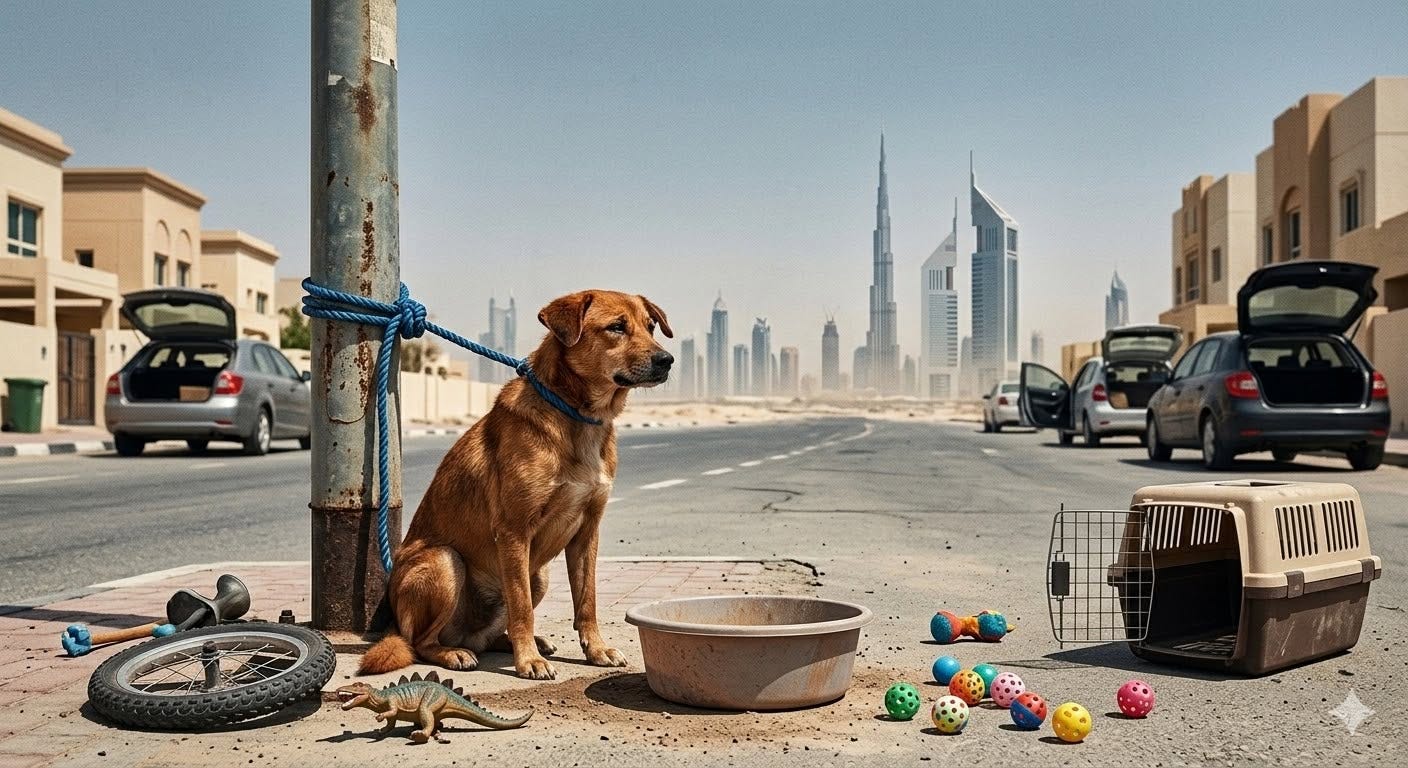
In Dubai, as tens of thousands of expatriates scrambled to leave, hundreds of pets were abandoned. Dogs were found tied to lampposts without food or water. Boxes of kittens were left on shelter doorsteps overnight with handwritten notes from owners explaining they could not take them. In Al Ain, a resident found a cat and four kittens in a cage on her doorstep. Veterinary clinics across the UAE reported a surge in requests to euthanize healthy animals because their owners could not arrange transport or would not pay relocation costs. At least two dogs were shot dead in the desert by owners attempting to cross into Oman who were told they could not bring animals across the border. K9 Friends Dubai, one of the emirate’s largest dog rehoming organizations, said it had been overwhelmed with calls for abandoned puppies and owners wanting to leave pets behind. The Barking Lot, a pet boarding facility, reported hundreds more animals than usual being left in its care. Pet relocation inquiries jumped 2,000 percent in the first week. The airlines were not taking animals. The roads out were restricted. The shelters were full. And in the desert heat, an abandoned dog tied to a post does not last long.
Dubai Street Kitties posted to social media: “We are at full capacity. Every room is full. Every space is taken. And still, the calls do not stop.” Louise Hastie, CEO of the charity War Paws, put it plainly: “Some people just don’t see pets the way we do. Abandoning pets at the border or on the streets, not even leaving them with the vet, there is really no excuse for it.”
The RSPCA urged owners to have a plan for their pets before leaving. Hannah Mainds, chief executive of the Blackpool and North Lancashire RSPCA branch and a former Dubai resident, said: “People will understandably be deeply concerned for their safety amid rising tensions. But animals shouldn’t become the forgotten victims when people leave the country in a crisis.”
The initial wave of abandonment in March was followed by a slower, more insidious bleed. Expatriates who stayed through the first weeks of the war, hoping for a quick resolution, gradually gave up as the Strait of Hormuz remained closed and missile strikes continued. One volunteer reported seeing around 200 posts on WhatsApp and Facebook groups about dogs abandoned on the streets and tied to poles. Anso Stander, owner of the Six Hounds shelter in Al-Ain, received 27 messages about abandoned pets in a single day and documented cases of animals abandoned in the desert near the Omani border after being denied clearance to cross. As of June 2026, thousands of feral dogs and cats still populate the streets of Dubai and Abu Dhabi. The shelters remain at capacity. The animals that survived did so in a landscape forever altered, domestic creatures turned wild, dependent on a human population that had largely vanished.
ON THE WATER, 20,000 SEAFARERS WERE STRANDED
Twenty thousand seafarers, men and women, were stranded on ships anchored across the Persian Gulf. The International Maritime Organization’s Secretary-General, Arsenio Dominguez, called it “unacceptable and unsustainable,” describing crews under heightened risk and considerable mental strain. These were cargo sailors, tanker crews, container ship workers, trapped on vessels that could not move because no insurer would cover the transit and no captain would risk the strait. They were not in combat. They were not evacuees. They were simply stuck, watching missiles fly overhead while their ships sat at anchor. At least six seafarers were killed across multiple vessel incidents since February 28. On March 6, the UAE-flagged salvage tug Mussafah 2 was struck by two missiles while sailing to assist the abandoned container ship Safeen Prestige. Four of the tug’s crew were killed and three more severely injured. They had been sent to help. They became targets.
THE SEA
The Persian Gulf is one of the most biologically diverse and ecologically fragile marine environments on Earth. It is a semi-enclosed, shallow sea, averaging just 36 meters deep, connected to the Indian Ocean only through the narrow Strait of Hormuz. Its slow water renewal limits the dispersion of pollutants. More than 700 species of fish have been recorded in its waters, along with five types of sea turtles, Arabian humpback whales, Indo-Pacific humpback and bottlenose dolphins, whale sharks, sea snakes, and approximately 60 species of reef-building coral. Among those corals is Acropora arabensis, found nowhere else on Earth. The Gulf also supports the world’s second-largest population of dugongs, estimated at 7,500 individuals, grazing on the largest continuous seagrass beds in the world in the shallow waters west of Abu Dhabi and south of Qatar.
This entire ecosystem is now under siege.
Oil spills in the Persian Gulf increased roughly four times by weighted area in March 2026 compared to the previous year, according to new research from the University of South Florida’s Optical Oceanography Lab. “This was a huge expansion of the oil footprint,” said Brian Barnes, research assistant professor in the College of Marine Science. “We knew there would be some level of change but did not expect the amount we saw.” By April, satellite images showed spills visible from space: a slick spanning more than five miles near Iran’s Qeshm Island, oil leaking toward Shidvar Island (a protected wildlife refuge known as Iran’s Maldives), oil off Kuwait’s coast following Iranian strikes on petrochemical facilities there, and thick oil slicks in the Khuran Strait directly adjacent to the Hara Biosphere Reserve.
The Hara Biosphere Reserve is the largest mangrove forest in the Gulf and a critical habitat for migrating birds, fish species, and endangered turtles. The Iranian drone carrier Shahid Bagheri, struck by a US warplane on March 6, has remained grounded in shallow waters in the ecologically sensitive Khuran Strait, leaking continuously. Satellite analyst Tim Richards warned the slick could become “the most ecologically significant in the region since the first Gulf war.” Circulating currents in the strait are pushing the contaminated water directly toward the mangrove areas despite tidal shifts.
Cleanup is not happening. Greenpeace Germany’s Nina Noelle said the spills would be extremely difficult to clean, if at all possible, due to “structural complexity, limited accessibility and challenging working conditions,” adding that the ongoing conflict makes gaining access to the Gulf to clean it up all but impossible.
Razan Khalifa Al Mubarak, the UAE’s Special Envoy for Nature, published a commentary in Mongabay in May 2026 laying out what the accumulation means: “What is at stake today is not only the repetition of past damage, but its amplification across interconnected systems. The gulf underpins both regional livelihoods and a significant share of the global energy system. Environmental damage would not remain contained.”
The 1991 Gulf War oil spill killed more than 30,000 seabirds, grebes and cormorants among them, representing over 50 percent of the wintering populations of some species in the northern Gulf. Across all animal types, researchers estimate 114,000 animals were harmed or killed, including 102 species of birds, sea turtles, bottlenose dolphins, and whales. That spill contaminated 640 kilometers of Saudi coastline. Hydrocarbons penetrated up to 50 centimeters into Gulf sediments and remained detectable 12 years after the spill. Some areas still carry bitumen beneath a thin layer of sand. The 2026 conflict has layered new contamination on top of that unresolved residue, on top of decades of coastal development, desalination brine discharge, and chronic oil pollution from routine shipping.
Beyond the spills, underwater explosions and sustained military sonar generate noise and shock waves that disorient whales, dolphins, and turtles, and can cause hearing loss or physical injury. For Arabian humpback whales, already critically endangered and nonmigratory, there is no refuge. Hawksbill and green sea turtle nesting sites on offshore islands between Iran and the UAE are in the direct path of the spill zone. “It’s well documented that oil spills in UAE waters lead to turtle mortality,” said Aaron Bartholomew, professor of biology at the American University of Sharjah. “They basically die in the oil spill itself and then wash up on shore.”
The sinking of at least nine Iranian warships adds another layer. Sunken military vessels carry bunker fuel, hydraulic oils, lubricants, and munitions, all of which corrode and leach into surrounding waters over years and decades. The Gulf’s warm, shallow conditions accelerate corrosion. A 2023 IUCN brief estimated that globally, over 8,500 shipwrecks are at risk of leaking approximately six billion gallons of oil. These nine newly sunken warships are now permanent fixtures on the seabed of one of the most ecologically sensitive bodies of water on the planet.
The whale shark gathers in the Persian Gulf between April and September to feed on the eggs of spawning mackerel tuna in offshore waters near Qatar. That migration coincided precisely with the war’s most intense period. These filter-feeders navigated oil-contaminated water and acoustic disruption from military sonar and explosions, among hundreds of anchored vessels in their feeding grounds.
Kaveh Samimi-Namin, a marine biologist at Naturalis Biodiversity Center who grew up in Iran, said: “These environments are on the edge. Anything that happens that impacts the environment can really push those animals, that biodiversity, off the cliff.”
Fieldwork is impossible. Monitoring is suspended. As one scientist noted, this constitutes “a major obstacle to conducting medium-term scientific studies, particularly for understanding ecosystem variations over several months or years.” Decades of research are at risk of being lost before scientists have even fully understood what is here and how the ecosystem really works.
INLAND: THE FORESTS AND THEIR ANIMALS
The destruction did not stop at the water’s edge.
The Zagros Mountains of western Iran contain 6 million hectares of oak forest, home to wolves, Persian leopards, Persian squirrels, and the Persian fallow deer, a species once thought to be extinct. These forests feed more than 50 percent of Iran’s livestock and include some of the country’s most important riverine sources of fresh water.
Airstrikes on military and industrial targets in Lorestan, Kermanshah, Ilam, and surrounding provinces ignited woodland fires. Environmental activists and rangers risked their lives with minimal equipment to contain fires that spread into neighboring protected areas and burned for days. They witnessed herds of goats and deer fleeing the flames from the Seifidkouh Reserve, birds scattering from burned oak forests, and entire species displaced from their habitats. In Lorestan’s Seifidkouh highlands, a downed Israeli Hermes drone discovered by local rangers made plain how far into protected territory the hostilities had reached.
Dr. Naghmeh Mobarghaee Dinan, a member of the Supreme Council for Environmental Protection of Iran, said the conflict represents “a crisis that goes beyond the battlefield, with consequences for ecosystems, wildlife, and public health that we are only beginning to understand.” She noted that bombardments generated extraordinary levels of chemical and light pollution, and intense vibrations that can rupture eardrums, disrupt cardiovascular rhythms, and cause fatal shock in animals, while chronic airwave pressure can impair photosynthesis and damage plant structures.
Strikes on the South Pars gas complex near Kangan and on refineries and petrochemical facilities contaminated soil and waterways across a wide area. The Zagros oak trees grow slowly. It could take 100 years for burned areas to recover.
THE STARVED
The Middle East is the world’s largest importer of wheat and rice, and the second-largest importer of corn. The closure of the Strait of Hormuz created a near-complete sea access denial for Middle Eastern grain and feed imports.
Iran imports approximately 4.3 million metric tons of corn annually. Iranian feed mills and poultry farms typically maintain only 14 to 21 days of forward supply. By mid-March 2026, with inflows halted, Iranian poultry producers were forced into mass premature culls, creating a temporary oversupply of meat followed by a prolonged protein vacuum.
Saudi Arabia’s large-scale integrated poultry sector, where the top seven producers control 87 percent of slaughter volume, relies entirely on imported corn, soy, and feed additives. Gulf nations with food reserves of three to six months faced acute shortages as the crisis extended beyond the second quarter of 2026.
In Lebanon, IFAW’s partners on the ground reported rescue operations for animals caught in airstrikes and displacement. Animals Lebanon removed 241 animals from war zones and distributed 731 kilograms of pet food. Give Me A Paw rescued 132 animals and reunited 81 with their families. The Lebanese Association for Migratory Birds saved one horse, 18 rabbits, two white storks, and two barn owls. Give Me A Paw also rescued 12 dogs and two cats from an abandoned pet shop in an area affected by airstrikes, some of which had already died before rescuers arrived. A horse named Amir, whose owner’s home and barn were destroyed in attacks, was taken in for veterinary care and temporary shelter.
In Gaza, the numbers are not a crisis. They are an annihilation. Before we count the animals, we must say what was done to the people.
By June 14, 2026, according to Gaza’s Ministry of Health as reported by UNRWA, 72,996 Palestinians had been killed and another 173,246 injured since October 7, 2023. Ninety percent of the population has been displaced. Half a million people face starvation. The war has caused more than 21,000 children to be disabled.
Israel shut Gaza’s border crossings on February 28, 2026, the same day Operation Epic Fury began, cutting off humanitarian aid at the exact moment the Iran war started. Famine was officially declared in Gaza City in August 2025. Amnesty International documented in multiple reports that the starvation was deliberate policy, starvation used as a weapon of war. The UN Security Council was told that clinics were “almost silent,” filled with emaciated children who “did not have the strength to speak or even cry out in agony.” One child wrote: “I wish I was in heaven where my mother is. In heaven there is love, there is food and water.”
Gaza has the highest number of child amputees per capita in the world. UNRWA Commissioner-General Philippe Lazzarini confirmed up to 4,000 amputations reported since October 2023. WHO’s representative in Gaza said in January 2026: “I’ve never seen so many amputees in my life, including among children.” The majority of those operations were performed without adequate anesthesia because Israel’s blockade prevented medical supplies from entering. By July 2025, more than 18,000 children had been listed among the war dead by Gaza health authorities, not counting those buried under rubble or killed by indirect causes.
The same blockade that killed the children killed the animals. They died together, in the same streets, under the same bombs, from the same deliberate denial of everything needed to live. By December 2025, updated FAO figures put cattle survival at just 0.5 percent. Livestock survival rates have fallen to 33 percent of goats and 20 percent of sheep compared with pre-conflict levels. The survival rate for poultry stands at 11.4 percent, with the vast majority of remaining farms unable to operate. Over two-thirds of Gaza’s cropland has been destroyed.
Before October 7, 2023, Gaza had approximately 15,000 cows, 60,000 sheep, 10,000 goats, and 20,000 donkeys. Donkeys and mules became the main mode of transport, used to carry people, aid, the injured, and the dead. By 2025, no more than 6 percent of those working animals remained. Starving cats and dogs were documented feeding on the corpses of their own kind and of humans who died in attacks but could not be retrieved.
Ward Saeed, displaced from El-Zetoun in Gaza’s old city, said: “We were displaced and moved south because of the war. We took our animals with us and lost half of them, most of them, along the way. These are the only animals left, and they are our only livelihood source.”
THE FISHERS AND THE FISH
The war did not stay in the Gulf. It traveled outward along fuel lines and shipping routes and hit the water everywhere.
Diesel prices rose 60 to 120 percent in fishing communities across the Global South within weeks of February 28. Fuel accounts for 30 to 50 percent of a small-scale fisher’s operating costs in normal times. At these prices, going to sea meant losing money. So boats stayed docked.
In the Philippines, which imports 98 percent of its fuel from the Middle East, fisherfolk groups reported diesel costs rising nearly 120 percent in March. Trips that once lasted eight to ten hours were shortened to four to six, or abandoned entirely. The country’s 2.7 million registered fisherfolk received a one-time government subsidy of $50 each to help absorb the shock. That is what a war looks like from a fishing dock in Cavite.
In Thailand, fisherman Bunyut Chaosamut kept his boat at anchor for two months. With a crew of ten to feed, house, and pay, he finally went back to sea even though his fuel bill exceeded half the cost of each trip and he was unable to raise the price of his catch. “I couldn’t keep my boat docked any longer,” he said. “My hands are tied.”
In Indonesia, the secretary general of the national tuna association said vessels that had returned to port would not go back out. The Dutch Fishers Union reported half its fleet tied up within weeks of the war starting. In South Korea, in Alaska, in Maine, the pattern repeated: boats at the dock, catches shrinking, fish populations left without the normal harvest pressure but also without the monitoring that tracks their health.
The World Forum of Fisher Peoples documented the pattern across Southeast Asia, Africa, and the Pacific. In Sri Lanka, diesel rose by 79 rupees per litre and kerosene by 60, making daily coastal trips unviable. In Europe, operators in Guernsey warned that sustained high prices were accelerating the long-term decline of an industry already struggling for survival.
This is not only an economic crisis. It is an ecological one with a delayed fuse. Reduced fishing pressure on some stocks may offer temporary relief. But in other areas, desperate fishers working fewer trips may resort to illegal gear to maximize short-term returns, compressing years of overfishing into a single desperate season. And across the Global South, fish is the primary affordable protein source for hundreds of millions of people. When the boats stop going out, the protein disappears from the plate. When the plate empties, the hunger begins.
Manuel Barange, director of FAO’s Fisheries and Aquaculture Division, said: “If elevated fuel prices persist over a longer period, the pressure on the sector could intensify and affect market dynamics.” That is the cautious language of a bureaucrat. What it means on the water is that families who have fished the same coastline for generations are being forced to stop, not by a storm, not by a drought, but by a war fought in a body of water thousands of miles away.
THE BIRDS
The Arabian Peninsula and Iran together form one of the great crossroads of the Earth for migratory birds. Four major flyways converge in this region: the East Atlantic, Central Asian, East Asia-Australasian, and African-Eurasian. Hundreds of millions of birds pass through on routes between Europe, Central Asia, Africa, and South Asia every spring and fall. Iran alone has 558 documented bird species, including 63 that are globally threatened. The Anzali Wetland on the Caspian coast, an internationally protected Ramsar site, hosts 140,000 birds from 254 species and is a critical stop on the Afro-Eurasian and Central Asian flyways. The Shadegan marshes in Khuzestan, another Ramsar site, supports flamingos, pelicans, and dozens of species of wading birds.
Oil spills suffocate and kill seabirds by destroying the waterproofing of their feathers, causing hypothermia and drowning. The 1991 Gulf War spill killed more than 30,000 seabirds in the northern Gulf, representing over 50 percent of the wintering populations of some species. The 2026 conflict has generated oil spills four times larger by weighted area in their first month alone.
The Gulf’s coastal mudflats, which Scientific American describes as “crucial feeding sites for migratory birds,” are directly in the path of the spreading contamination. Smoke plumes from burning tankers and petrochemical facilities create toxic corridors through which millions of birds must navigate during spring migration. Explosions cause birds to scatter, abandon feeding grounds, and burn critical energy reserves. For species already stressed by habitat loss and climate change, these disruptions can mean the difference between surviving migration and not.
Israel, flanked by desert to its east and the Mediterranean to its west, is one of the great bird migration bottlenecks on Earth, through which hundreds of millions of birds travel between Europe, Asia, and Africa each spring and fall. The spring migration peaks in March and April, the precise period when the Iran war was at its most intense. The Hula Lake Park in northern Israel, one of the most important migration observation sites in the region, was closed to visitors during the missile exchanges. Staff reported birds landing temporarily after the loud bangs of missile interceptions. Ornithologists noted that while major diversions would likely be short, any deviation during peak migration burns energy reserves birds cannot afford to lose before breeding season.
Experts and regional observers have warned that smoke plumes, pollution, and repeated explosions linked to the conflict could disrupt bird movement along Arabian Gulf routes. What no one can yet measure is what happens across an entire flyway when millions of birds encounter contaminated water, toxic smoke, and the acoustic chaos of a shooting war at the exact moment they need food, rest, and safe passage.
IRAN’S WETLANDS
The bombing campaign did not only hit cities and military installations. It hit Iran’s interior, and the interior of Iran is filled with some of the most ecologically significant wetlands on Earth.
Iran has 25 internationally protected Ramsar wetland sites covering nearly 1.5 million hectares. They include the Shadegan marshes in Khuzestan, one of the largest tidal marshes in the world, a home to flamingos, pelicans, and Smooth-coated otters. They include the Hara Biosphere Reserve in the south, already threatened by the Shahid Bagheri oil spill. They include the Anzali Wetland on the Caspian coast, a freshwater lagoon hosting critically endangered stellate sturgeon and dozens of species of waterbirds critical to the Afro-Eurasian flyway.
Airstrikes on military and industrial targets across western Iran, on oil facilities, refineries, petrochemical complexes, and ammunition depots, released toxic chemicals into soil and waterways that drain toward these wetlands. The Zagros mountain range, where much of the bombing occurred, is the headwater source for rivers that feed Khuzestan’s wetlands. Contamination that enters those rivers does not stay in the rivers.
No environmental monitoring is possible during active conflict. Scientists cannot access the sites. What is entering these internationally protected ecosystems from the strikes on industrial targets in their upstream watersheds will not be known, in many cases, for years. By then, the birds that depend on the Anzali Wetland for migration staging, the fish that spawn in the Shadegan marshes, the otters and pelicans of Khuzestan, will have absorbed what we do not yet know to measure.
THE GLOBAL LIVESTOCK CASCADE
The war’s reach into livestock sectors around the world has been almost entirely unreported in relation to the animals themselves. The numbers exist at the commodity level. What they represent at the level of living creatures is rarely said.
The WFP estimated that if oil prices remained above $100 per barrel beyond June 2026, the number of people facing acute hunger globally could increase by 45 million. That estimate moves through the food system. It means animals culled because feed cannot be afforded. It means livestock left without veterinary care because veterinary supply chains run through the same disrupted shipping routes. It means poultry farms shuttered and herds downsized across regions that had nothing to do with the decision to launch Operation Epic Fury.
Urea prices at the US New Orleans import hub jumped 77 percent between mid-December 2025 and March 9, 2026. Urea is the primary nitrogen fertilizer for grain crops. Grain crops are what livestock eat. When fertilizer prices spike, feed grain prices follow. When feed grain prices spike, the animals that eat grain are the first to go.
In the Netherlands, Wageningen University researchers noted that the most vulnerable part of that country’s food system is its intensive livestock sector, which relies heavily on cheap imported animal feed and exported meat and dairy. “If that system is disrupted,” one researcher said, “the sector quickly runs into trouble.” Across Africa, countries that had become heavily dependent on cheap food imports faced the removal of that supply precisely when domestic agriculture was entering planting season with fertilizer prices they could not absorb.
The Southeast Asian shrimp sector, where intensive aquaculture depends on diesel-powered aeration systems, was hit simultaneously by the feed cost spike and the fuel price spike. Higher energy costs for aeration mean less oxygen in the water. Less oxygen in the water means higher mortality in the tanks. The fish die before they reach the plate.
These cascades are invisible in the war’s accounting. No satellite images them. No body count includes them. But across dozens of countries on every continent, animals that had nothing to do with Hormuz, with Kushner, with Operation Epic Fury, with any of it, are paying for it in the only currency they have.
THE RECKONING
As of June 22, 2026, Day 114 of the crisis, the Strait of Hormuz is effectively closed to commercial shipping. A memorandum of understanding was signed June 17, brokered by Pakistan, with Qatar, Saudi Arabia, Turkey, and Egypt facilitating, and intended to bring the conflict to a formal end within 60 days. But on June 20, Iran’s IRGC re-declared the strait closed, citing Israel’s continued strikes in Lebanon as a ceasefire violation. US-Iran talks resumed Sunday in Switzerland at Bürgenstock, where negotiators reached agreement on a de-confliction communication channel on June 21, but stumbled on the question of Iran’s uranium enrichment. The US and Iran are giving conflicting accounts of what is moving through the water. CENTCOM says 55 ships transited Saturday. Maritime intelligence firm Windward counted 12 on Sunday, down from 35 the previous day. Eight of the world’s largest container carriers, including Maersk, MSC, CMA CGM, and Hapag-Lloyd, remain on Cape of Good Hope routing and have restructured their schedules for the rest of 2026. War-risk insurance is running at eight times normal. Ian Ralby, a maritime security expert and CEO of I.R. Consilium, told CBC News the strait is not open in any meaningful way. Approximately 550 vessels remain stranded on either side. Analysts estimate four months to full normalization once a genuine reopening holds. ADNOC, the UAE state oil company, has said full flows through Hormuz will not resume until 2027 even if the deal survives.
For the animals of the Persian Gulf, none of this means the crisis is over.
The oil slicks remain. The Shahid Bagheri still sits in the Khuran Strait, still leaking, its heavy fuel oil still moving toward the Hara mangroves with each tidal cycle. The nine sunken warships continue to corrode. The seagrass meadows, deprived of sunlight by oil and sediment, struggle to photosynthesize. The dugongs, displaced by noise and habitat degradation, search for food in increasingly barren waters. The feral dogs and cats of Dubai breed and scavenge in a city half-empty of the human population that brought them there. The livestock of Iran, culled in their millions, leave a protein vacuum that will take years to fill. The working donkeys of Gaza, those few that remain, still carry the dead and the injured on exhausted legs.
The 1991 Gulf War killed more than 30,000 seabirds and harmed or killed 114,000 animals in total. It contaminated 640 kilometers of coastline. It took decades for some species to recover. Some habitats never did. The 2026 conflict layered new trauma on top of that unresolved damage, on top of climate change, coastal development, and chronic pollution. Whether the Gulf’s ecosystems can absorb it is a question scientists are watching with deep concern.
The dog tied to the lamppost. The whale shark swimming through oil-slicked water. The Persian leopard fleeing an oak forest set on fire by a missile strike. The mariner watching missiles from an anchored ship they cannot leave. The caged cat left on a doorstep in Al Ain. The horse standing in a Lebanese shelter after his barn was destroyed. The dugong grazing in a seagrass meadow that may not survive the summer.
These are the costs that do not fit in a spreadsheet. They are the ones that make a war real.
Copyright © Mark A. Shryock. May be shared with attribution.
SOURCES
Newsweek, “Dubai Residents Accused of Abandoning Pets As They Flee,” March 11, 2026. https://www.newsweek.com/dubai-residents-accused-abandoning-pets-evacuations-iran-wa-11660228
Wake Up Singapore, “Pets Abandoned in Dubai as Iran-related Missile Strikes Force Expats to Flee,” March 14, 2026. https://wakeup.sg/pets-abandoned-dubai/
CNN, “The Stunning Underwater World That’s at Risk as the Iran War Drags On,” April 17, 2026. https://www.cnn.com/2026/04/17/science/strait-of-hormuz-marine-animals
CNN, “Oil Spills from the Iran War Are Visible from Space,” April 21, 2026. https://www.cnn.com/2026/04/21/climate/iran-war-oil-spills-persian-gulf-satellite-images
University of South Florida College of Marine Science, “Oil Spills Spiked in the Persian Gulf During the Iran War, According to New Study,” June 2026. https://www.usf.edu/marine-science/news/2026/oil-spills-spiked-in-the-persian-gulf-during-the-iran-war-according-to-new-study.aspx
Jiao, Junnan, Chuanmin Hu, and Brian B. Barnes, “Conflict-Induced Oil Spills in the Persian (Arabian) Gulf in March 2026: A Multi-Sensor Assessment,” SSRN preprint under review at Marine Pollution Bulletin, May 22, 2026. https://papers.ssrn.com/sol3/papers.cfm?abstract_id=6815353
TRT World / Anadolu Agency, “Oil Spill from Bombed Iranian Naval Ship Threatens Gulf Mangrove Reserve,” April 8-9, 2026. https://www.trtworld.com/article/359f98202b58
Live Science, “Oil Spills from Iran War May Contaminate Water and Food Supply and Threaten Protected Wildlife Refuge,” April 22, 2026. https://www.livescience.com/planet-earth/rivers-oceans/oil-spills-from-iran-war-may-contaminate-water-and-food-supply-and-threaten-protected-wildlife-refuge
Scientific American, “The War in Iran Is Supercharging an Ecological Crisis in the Persian Gulf,” May 14, 2026. https://www.scientificamerican.com/article/the-war-in-iran-is-supercharging-an-ecological-crisis-in-the-persian-gulf/
Seven Seas Media, “Beneath the War Zone, the Persian Gulf’s Marine Ecosystem Faces Its Next Great Test,” March 4, 2026. https://sevenseasmedia.org/persian-gulf-marine-ecosystem-war-oil-tankers-coral-reefs-dugongs/
Razan Khalifa Al Mubarak, “Arabian Gulf’s Fragile Marine Ecosystem Threatened by Current Crisis,” Mongabay, May 12, 2026. https://news.mongabay.com/2026/05/arabian-gulfs-fragile-marine-ecosystem-threatened-by-current-crisis-commentary/
Gulf International Forum, “After the Silence: Iran Confronts the Environmental Fallout of War,” 2026. https://gulfif.org/after-the-silence-iran-confronts-the-environmental-fallout-of-war/
Center for American Progress, “The Human and Environmental Costs of the War in Iran,” April 20, 2026. https://www.americanprogress.org/article/the-human-and-environmental-costs-of-the-war-in-iran/
Greenpeace International, “The US-Israel War on Iran and How War and Conflict Are Destroying the Environment,” March 18, 2026. https://www.greenpeace.org/international/story/82201/iran-lebanon-war-environment-climate-impacts/
Conflict and Environment Observatory (CEOBS), “Iran War: Environmental Risk Overview as of 27th March,” 2026. https://ceobs.org/iran-war-environmental-risk-overview-as-of-27th-march/
FAO, “Protecting Livelihoods and Lives in Gaza.” https://www.fao.org/newsroom/story/protecting-livelihoods-and-lives-in-gaza/en
UN Security Council Press Release, “Gaza’s Population Systematically Being Starved to Death,” August 27, 2025. https://press.un.org/en/2025/sc16157.doc.htm
Amnesty International, “Israel/OPT: New Testimonies Provide Compelling Evidence That Israel’s Starvation of Palestinians in Gaza Is a Deliberate Policy,” August 19, 2025. https://www.amnesty.org/en/latest/news/2025/08/israel-opt-new-testimonies-provide-compelling-evidence-that-israels-starvation-of-palestinians-in-gaza-is-a-deliberate-policy/
Amnesty International, “Gaza: Evidence Points to Israel’s Continued Use of Starvation to Inflict Genocide Against Palestinians,” July 4, 2025. https://www.amnesty.org/en/latest/news/2025/07/gaza-evidence-points-to-israels-continued-use-of-starvation-to-inflict-genocide-against-palestinians/
TRT World, “UN, EU Sound Alarm Over Children in Gaza: Starving, Amputated, Traumatised,” September 24, 2025. https://www.trtworld.com/article/3c3872ea8347
Wikipedia, “Gaza Humanitarian Crisis.” https://en.wikipedia.org/wiki/Gaza_humanitarian_crisis
Wikipedia, “Gaza Strip Famine.” https://en.wikipedia.org/wiki/Gaza_Strip_famine
Defense for Children Palestine, “No Safe Place: The Starvation, Torture, and Killing of Palestinian Children in 2025.” https://www.dci-palestine.org/no_safe_place_starvation_torture_and_the_killing_of_palestinian_children_in_2025
Plan International, “Children at Gravest Risk as Full-Fledged Famine Unfolds in Gaza,” August 22, 2025. https://plan-international.org/news/2025/08/22/children-gravest-risk-full-fledged-famine-unfolds-gaza/
FAO / UN Media, “Gaza Agricultural Damage,” December 24, 2025. https://media.un.org/unifeed/en/asset/d353/d3534369
FAO, “Gaza Strip: Amid Ceasefire, FAO Helps Herders Protect Remaining Livestock, Combat Malnutrition,” December 2, 2025. https://www.fao.org/neareast/news/details/gaza-strip-amid-ceasefire-fao-helps-herders-protect-remaining-livestock-combat-malnutrition/en
IFAW, Lebanon Conflict Animal Rescue Operations, 2026.
IMO, Secretary-General Statement, March 6, 2026; Marine Insight, March 6, 2026; Seatrade Maritime, March 8, 2026; USNI News, March 10, 2026.
Wikipedia, “Gulf War Oil Spill.” https://en.wikipedia.org/wiki/Gulf_War_oil_spill
Symens, P. and Suhaibani, A., “The Impact of the 1991 Gulf War Oil Spill on Bird Populations in the Northern Arabian Gulf,” published review, Academia.edu. https://www.academia.edu/78008079/The_impact_of_the_1991_Gulf_War_oil_spill_on_bird_populations_in_the_northern_Arabian_Gulf_a_review
CEDRE, “Gulf War 1991 Oil Spill.” https://wwz.cedre.fr/en/Resources/Spills/Spills/Gulf-War
Science, “Protect Iran’s Zagros Forests from Wildfires.” https://www.science.org/doi/10.1126/science.abd2967
World Forum of Fisher Peoples, “The Fuel Crisis Triggered by the 2026 Iran War: Severe Impacts on Small-Scale Fisheries Worldwide,” April 5, 2026. https://wffp-web.org/the-fuel-crisis-triggered-by-the-2026-iran-war-severe-impacts-on-small-scale-fisheries-worldwide/
The New Humanitarian, “Iran War Pushes Philippines Fishing Communities to the Brink,” April 6, 2026. https://www.thenewhumanitarian.org/photo-feature/2026/04/06/iran-war-impact-philippines-fishing-communities
Reuters / KFGO, “Fishing Boats Worldwide Stuck Dockside as Diesel Prices Surge on Iran War,” May 21, 2026. https://kfgo.com/2026/05/21/fishing-boats-worldwide-tuck-dockside-as-diesel-prices-surge-on-iran-war/
ICSF, “As Iran Conflict and US Tariffs Exact Costs, Fishers Across Southeast Asia Struggle to Stay Afloat,” May 2026. https://icsf.net/newss/as-iran-conflict-us-tariffs-exact-costs-fishers-across-southeast-asia-struggle-to-stay-afloat/
SeafoodSource, “Asian Fishers Hoping Possible Iran-US Peace Deal Brings Relief,” June 2026. https://www.seafoodsource.com/news/supply-trade/asian-fishers-hoping-possible-iran-us-peace-deal-brings-relief
The Confluence, “How Conflict in the Strait of Hormuz Is Devastating Local Fisheries and Ecosystems,” March 11, 2026. https://theconfluence.news/p/how-conflict-in-the-strait-of-hormuz
Khaleej Times, “US-Israel-Iran War Could Disrupt Migratory Birds Along Arabian Gulf Routes,” March 12, 2026. https://www.khaleejtimes.com/world/gulf/us-israel-iran-war-could-disrupt-migratory-birds-along-arabian-gulf-routes
Times of Israel, “War Will Not Interrupt Annual Migration of Millions of Birds Through Israel — Expert,” March 10, 2026. https://www.timesofisrael.com/war-will-not-interrupt-annual-migration-of-millions-of-birds-through-israel-expert/
Ornithological Society of the Middle East, Iran Country Profile. https://osme.org/country-profiles/iran/
Ramsar Convention, Anzali Wetland Site Information. https://rsis.ramsar.org/ris/40
Tehran Times, “25 Wetlands of International Importance in Iran.” https://www.tehrantimes.com/news/444727/World-Wetlands-Day-25-Wetlands-of-International-Importance-in
EW Nutrition / The Cattle Site, “The Middle East Conflict: Implications for Feed and Animal Producers,” March 2026. https://ew-nutrition.com/the-middle-east-conflict-implications-for-feed-animal-producers/
CSIS, “Chokepoint: How the War with Iran Threatens Global Food Security,” 2026. https://www.csis.org/analysis/chokepoint-how-war-iran-threatens-global-food-security
CSIS, “Iran, Fertilizer, and Food Security: Risks, Impacts, and Policy Responses,” April 7, 2026. https://www.csis.org/analysis/iran-fertilizer-and-food-security-risks-impacts-and-policy-responses
IFPRI, “The Iran War: Potential Food Security Impacts,” March 17, 2026. https://www.ifpri.org/blog/the-iran-war-potential-food-security-impacts/
Wageningen University, “Rising Food Prices Due to the War in Iran: Causes and Consequences,” March 16, 2026. https://www.wur.nl/en/longread/rising-food-prices-due-war-iran-causes-and-consequences
Britannica, “2026 Iran War.” https://www.britannica.com/event/2026-Iran-war
CNBC, “Shipping Stalls in Strait of Hormuz After Iran Declares Key Waterway Closed Again,” June 22, 2026. https://www.cnbc.com/2026/06/22/strait-of-hormuz-iran-us-shipping-oil.html
Al Jazeera, “Shipping Stalls in Strait of Hormuz After Iran Declares Key Waterway Shut,” June 22, 2026. https://www.aljazeera.com/economy/2026/6/22/shipping-stalls-in-strait-of-hormuz-after-iran-declares-key-waterway-shut
CBC News, “The U.S. Says It’s Open. Iran Says It’s Closed. The Strait of Hormuz Remains Precarious,” June 22, 2026. https://www.cbc.ca/lite/story/9.7243819
Global Energy Flow, “Is the Strait of Hormuz Open? Live Status,” June 22, 2026. https://global-energy-flow.com/hormuz/
Mondoweiss, “The U.S. Occupation of Gaza Has Begun,” January 30, 2026. https://mondoweiss.net/2026/01/the-u-s-occupation-of-gaza-has-begun/
Wikipedia, “Board of Peace.” https://en.wikipedia.org/wiki/Board_of_Peace
Al Jazeera, “Map Shows What Would Happen to Gaza Under the US ‘Master Plan,’” January 27, 2026. https://www.aljazeera.com/news/2026/1/27/map-shows-what-would-happen-to-gaza-under-the-us-master-plan
NPR, “What Jared Kushner’s ‘New Gaza’ Plan Includes, and What It Leaves Out,” February 2, 2026. https://www.npr.org/2026/02/02/nx-s1-5694656/jared-kushner-new-gaza-plan
NBC News, “Jared Kushner’s Vision for Gaza as a Gleaming Port City Clashes with Reality,” January 24, 2026. https://www.nbcnews.com/world/gaza/jared-kushners-vision-gaza-gleaming-port-city-clashes-reality-rcna255569
Time, “What to Know About the Jared Kushner-Backed Luxury Resort Drawing Protests in Albania,” June 5, 2026. https://time.com/article/2026/06/05/jared-kushner-backed-luxury-resort-albania-protests/
Fox News, “Jared Kushner’s Overseas Luxury Resort Project Faces Anti-Corruption Investigation Amid Violent Protests,” June 2026. https://www.foxnews.com/politics/jared-kushners-overseas-luxury-resort-project-faces-anti-corruption-investigation-amid-violent-protests
House Judiciary Committee Democratic Staff, Letter to Jared Kushner re: Conflict of Interest, April 16, 2026. https://democrats-judiciary.house.gov/sites/evo-subsites/democrats-judiciary.house.gov/files/evo-media-document/2026-04-16-raskin-to-kushner-affinity-re-conflict-of-interest.pdf
Responsible Statecraft, “Not So Diplomatic: Witkoff, Kushner, and Trump’s March to War in Iran,” March 18, 2026. https://responsiblestatecraft.org/witkoff-iran-war/
Arms Control Association, “U.S. Negotiators Were Ill-Prepared for Serious Nuclear Negotiations with Iran,” March 11, 2026. https://www.armscontrol.org/blog/2026-03-11/us-negotiators-were-ill-prepared-serious-nuclear-negotiations-iran
Subscribing is completely free. I have disabled automatic email updates so my posts won’t clutter your inbox. If you choose to donate on Substack, please note it is a recurring commitment (though you can unsubscribe at any time).
For those who prefer a one-time support option, please copy and paste my Ko-fi link into your browser:
Thank you for writing this. I’m so tired of reading nearly everything written only in terms of human and/or economic costs, and never about the billions of other creatures we are killing.
Thank you for speaking for those who can not speak for themselves